If you are discussing about trees that are worth adoring around the world, the sequoia tree will definitely be a one to note and give so much consideration to.
Sequoias are the largest species of trees on the planet and it is an evergreen plant that has the ability to survive for about 3,500 years.
This tree belongs to the plant family Cupressaceae and it can reach a height of about 280 feet and width of 26 feet and it is known for its ability to produce scale-like leaves that are spirally arranged on the branches.
This tree is a monoecious tree, that is, it has both male and female reproductive organ i.e. the stamen and stigma on a single plant.
The sequoia tree is known for its high seed-producing capability and some species are capable of producing thousands of seeds on an annual basis and this tree does grow branches around the top half region of the stem.
Sequoia trees can be easily planted from seeds or seedlings depending on your choice and this operation is quite difficult, however, it is not impossible to carry out.
Generally, sequoia trees develop cones that bear seeds and the seeds derived from each cone do have a very low rate of viability.
Sequoia gives a prudent and fascinating look to the environment and they are very large trees that cannot be grown just anyhow because growing them in a spot that is not sufficient for their growth can result in damages.
The evergreen sequoia tree has the ability to reach a height that is spectacular and fascinating and this plant can help to give your yard or garden a decent and unique look – just make sure that the planting space is well-planned for possible growth in later years.
Growing your own sequoia tree from seed is a nice experience that everyone should have and this experience is very possible with just a few steps.
Are you a sequoia lover and you wish to grow your own large tree around your home? Do you want to learn some of the principles involved in growing sequoia tree from seed?
If you have a positive response to any of those questions then this is the right article for you. In this article, we will take you through the guidelines involved in growing your own large sequoia tree from seeds. Read, enjoy, and digest!
How to plant Sequoia tree
Growing your own sequoia tree from seed is an interesting experience to have as a gardener and having such a tree in your environment can be your way of giving a gift to the coming generations.
Big Pack – (500) Giant Sequoia, Sequoiadendron giganteum Tree Seeds
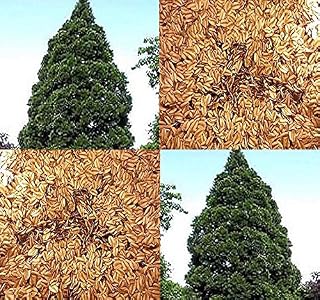
This lovely and beautiful plant can be conveniently grown but this can be a very tedious activity to engage in during the early stages and this activity also requires patience.
In this section of this article, we will take you through the simple steps to be followed when you decide on planting your sequoia tree. The steps involved are as follow:
Cone collection:
Sequoia trees do produce cones that can be collected at the base of the plant during the winter season (the normal period when they fall).
Mature sequoia trees do produce quite a number of cones and since you want to grow a tree from the seeds, cones that appear green are your best bet for greater viability outcome.
Also, choosing your own cone will give you a chance to know the mother plant and also be able to trace its genealogy. The cones produced have the appearance of a black-like scale on the brownish oval cones.
Dry the cones:
The cones that have been collected from the matured sequoia tree should be placed in a warm, dark, dry, well-ventilated area and allowed to dry.
The cone should be left at that singular spot for about three to five weeks when the separation of the scales can be easily observed.
Remove the seeds:
The dried cones should be ready to release the seeds after three to five weeks of subjecting to such conditions.
The seeds can be removed by shaking the dried leaves and allowing the seeds fall; using a newspaper for holding the leaves will definitely be of great essence.
Prepare the growing soil:
Without soil, it is practically impossible to grow plants. Sequoia trees do well in loamy soil so you should get that type of soil and fill a pot with it.
You can as well make use of a potting mix or a mixture of both (potting soil and loamy soil). The soil should be well-watered and make sure that the water drips out from the drainage hole on the pot.
The seed should be sprinkled on the prepared soil and covered with more potting soil and water again. NB: Just make sure the soil is kept moist at all times.
Place the prepared seeded pot in a plastic bag:
The seeded pot should be placed in a plastic bag and you should close the opened part with a rubber band to prevent air entry or escape.
The encompassed pot should be placed in a cool area that is never exposed to direct sunlight and the pot is to be removed daily to water. Make sure that the soil is kept moist.
Pay attention to the growing medium:
The seeded pot should be paid very good attention to and you should watch out for possible germination of seeds. Germinating seeds can be observed by the emergence of green sprouts from the soil; usually appearing bent.
Once germination is observed, the pot should be removed from the plastic bag and kept in a cool spot that is not exposed to the sun but receives indirect sunlight.
Allow to grow:
The plant should not be exposed to direct sunlight and it should be allowed to germinate to a considerable height.
The plant should be left for about 2 weeks at that particular position before transplanting is done. Once the development of about 3 – 5 foliage is observed, transplanting is possible at this stage.
Transplant the seedling:
Seedlings that are about 4 to 5 inches tall can be prepared for transplanting in a better spot. A bigger growing pot with drainage holes should be filled with potting mix and the seedling should be planted at the center of the soil.
The soil should be kept moist on a daily basis and you can improvise by misting the top of the plant to provide them with the wild-growing experience which can help improve their performance.
Acclimate the plant to the outer environment:
After allowing the plant to grow to a considerable height, the next line of action is to prepare them for their final destination.
This plant is to be exposed to full sunlight for a few hours per day and this can be increased as the day progress and this operation can be carried out within two weeks.
Site selection:
Choose a wide space that will accommodate the growth of the plant over the years. The soil must be well-draining and must be a place that receives full sunlight exposure during the day.
Preferably, choose a site that is rich in loam and will supply the necessary nutrients needed for the plants’ growth and development.
Transplant outdoors:
The matured plant should then be transplanted to the chosen and prepared site. Tilling the soil very deep will definitely help to ensure the ease of planting and also allowing the easy spread of the root.
After planting, keep the soil moistened at all times and watering should be carried out very early in the morning. You can add humus to the plant base before covering with topsoil to enhance the plants’ development.
Conclusion
Sequoia trees are one of the most beautiful and flamboyant trees around and learning to grow them can be a great addition to your garden.
Growing a sequoia tree is very easy to carry out; however, you need to be patient and very careful. Create a beautiful space for your home!
On behalf of the author, thank you so much for taking the time to read this article !
